

 I just received excellent news from the doctor’s office.
For the past couple of years we’ve been struggling to bring down my blood cholesterol. In the fall, my doctor said I’d plateaued just below the level of moderate risk for heart disease and, with no sign of improvement, she wanted me to start taking statins to control it. She gave me a prescription.
I told her I didn’t want to take statins. So I agreed to sign up for a year-long health program through the clinic. In November I started meeting with a nurse, a nutritionist and a kinesiologist once every three months.
I think a lot about food. I prepare most of our meals from scratch and try to make them balanced and healthy, but as of November my cholesterol had not responded.
So I decided to give up cheese. Close friends will know this was a painful sacrifice. The foods I love best are fruit, mushrooms, shellfish and cheese. Unfortunately, when I’m tired (which happens every evening) I loose discretion about what I eat. I was easily consuming two pounds of cheese a week.
This is by no means an argument that people should cut out cheese for heart health. Cheese is a good source of protein, and not the worst culprit where cholesterol is concerned. The nutritionist expressed doubts about eliminating it while still permitting butter and coconut oil.
The difference is that a teaspoon of butter on toast can pack a load of satisfying flavour. Cutting back to an appropriate daily serving of cheese was not going to work for me, because I was using cheese to satisfy an emotional craving – one that was never satisfied.
The only practical strategy was an outright ban, to begin with. Danny agreed, good man, because he loves it as much as I do. Initially I had in mind that we could have cheese once a month for a special treat.
Two months into the experiment, I’ve found it possible to buy cheese if it’s dedicated for a specific meal, usually low-fat. For example, last week we bought half a pound of low-fat mozzarella for a lasagna that gave us two meals.
When I open the fridge in the evening, I still crave that cheese, but can remind myself of its purpose. Instead I reach for something containing less fat. For my daily fix of richness, I’m relying more often on high-protein Greek yogurt or toast with a little butter. No more giant pig wedges every night before bed.
Krista, the kinesiologist, has been particularly helpful in achieving my exercise goals, phoning every two weeks to see how I’m doing. My goal is exercise six days a week: three days walking and three days of resistance training: essentially a high-energy workout that combines cardio with light weights to develop different muscle groups.
With winter weather, house hunting and getting ready to move, I’ve had a hard time staying on top of it, but the accountability has helped. In reality, I’ve been exercising four or five days a week, and it dropped off completely when I was sick in January. But I keep getting back on the horse. When I went for an extra check-in with Krista a month ago, I had lost six pounds since November.
Now for the good news. In preparation for my appointment with the health program trio next week, I went for blood tests yesterday. The results already came back to my doctor this morning. Her assistant called.
My bad cholesterol has come down significantly. I’m on target! She asked if I was taking statins. No, I didn’t get the prescription filled. I don’t need to take them, she said. The doctor wants me to continue with the health program for the full year, of course, which I will gratefully do.
My low-cheese diet is working. The key is treating it as an ingredient instead of a main course. A wedge of nippy whiskey cheddar or a silky Camembert disc sitting in the fridge at night would be harder to resist. Even those are candidates for special occasions, parties and birthdays. I like looking forward to things, and few things are more delicious to anticipate than cheese. But my relationship with it has changed, and my heart is thanking me.
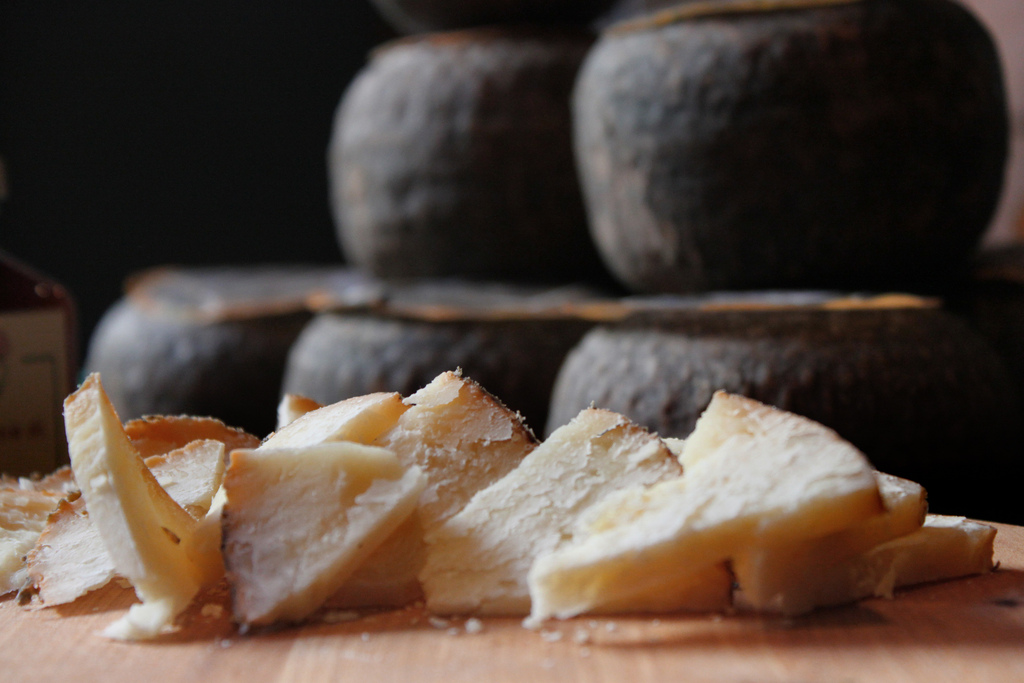
Photo courtesy of Graeme Mclean on Flickr via Creative Commons.
Lovely pic of cheese! And congrats on your progress toward good health! Keep it up.
self discipline is not easy! good for you and it will all be worth it!
I’m so glad you can avoid statins. I am trying to cut back on them as they give me leg cramps. I don’t like cheese much but I gave statins more of a miss lately and my levels are just a bit above 5. What about vegetables that help lower the bad cholesterol?
Any nfo you have would be welcome,Van.
I’d heard about muscle cramps and other problems, which was why I wanted to avoid statins. More vegetables are always a good thing. I could stand to eat more of them. I love fruit, but have to bribe myself to eat vegetables. I try to eat a salad every day for lunch; not only green salad, but also salads based on carrots, mushrooms, avocados and quinoa. I wrote about some of my favourites last year: https://www.vanwaffle.com/2013/02/19/daily-salad-is-a-healthy-pleasure/#sthash.bH9ZkGoK.dpbs . Unfortunately this habit doesn’t always stick.
Good for you for saying no to statins! They are bad news, with many deleterious side effects to combat, IMO, a nonexistent problem and make $$$ for Big Pharma. While I’m glad your health program is working, I disagree mightily with the idea that cholesterol itself is bad. It’s a substance the body generates and uses to combat inflammation in the arteries and other blood vessels. Its presence indicates the body is trying to return to balance, but Western medicine, with its reductionist approach, found it present in heart disease patients and concluded it was the enemy. What Western medicine failed to take into account was the new kinds of foods being consumed by modern people, namely margarines and partially-hydrogenated oils, that coincided with a rise in heart disease. My understanding is heart disease was relatively unknown until we were introduced to margarines and such. Maybe cheese has something in it that your body is allergic to, thereby generating inflammation. One thing recently learned is that some people naturally have high cholesterol, but it’s poorly understood as to why. Also, we are slowly finding that fat isn’t the demon it’s been made out to be for a few generations now, so I’m glad you are keeping butter and coconut oil in your diet. Best of luck, Van!
Thanks, Joe. I appreciate your previous warnings about statins. These factored into my decision, as did other people’s experiences with unpleasant side effects. If you’re suggesting that it’s safe to ignore high blood cholesterol, I don’t agree.
I was skeptical about cholesterol until my last appointment with the eye doctor. She asked,”Is your doctor treating you for high cholesterol?” I said, “We are aware that my cholesterol is high.” She said, “I don’t want to raise an alarm, I just wanted to make sure your doctor was on it.” Apparently she could tell from the appearance of the blood vessels in my eye. Considering my father, who was extremely and unusually fit for his age, had to have a triple bypass six years ago, I was alarmed.
From my research on celiac disease, I know that we barely understand what’s going on in our bodies, how we absorb food, what supports health and what leads to illness. But based on various factors including a history of heart disease in my family, with my level of the so-called bad cholesterol I was moving from low risk toward moderate risk. Neither I nor my doctor wanted me to become an early heart attack statistic.
Suggesting that I’m allergic to cheese obscures the importance of maintaining a healthy, balanced diet and exercise. There was little doubt in my mind that my diet was out of balance, with too much saturated fat and not enough complex carbohydrates. I don’t use the margarines and partially-hydrogenated oils you blame. There was also little doubt that my health would benefit from more vigorous and frequent activity. As a middle-aged writer I tend to be more sedentary than is good for me. And there was little doubt that it would be better to improve my lifestyle rather than using another drug as quick fix.
So maybe the next person can sit still all day, eat as much rich food as they want and put on weight without ever suffering diabetes or heart disease. Am I jealous? Yes. Are they lucky? Maybe, maybe not. Maybe it’s a good thing that I’m genetically susceptible to heart disease. It makes me think harder about my health.
Great post! I wish to subscribe to your newsletter.